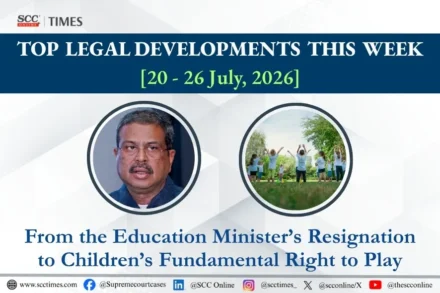
TOP LEGAL DEVELOPMENTS THIS WEEK [20-26 July, 2026] | From the Education Minister’s Resignation to Children’s Fundamental Right to Play
A quick roundup to cover all the important legal developments and cases this week.

Bringing you the Best Analytical Legal News


A quick roundup to cover all the important legal developments and cases this week.
“When a parent entrusts a child to a teacher, he on his behalf impliedly consents the teacher to exercise such authority over the student. When a student does not behave properly or act according to the rules of a school, and if the teacher gives him a corporal punishment for improving his character and conduct, the court has to ascertain whether the said act of the teacher was bona fide or not.”
“In the present case, despite the clear statement given by the survivor that the relationship between the appellant and herself was consensual in nature, he has been convicted under the POCSO Act only for the reason that on the date of incident she was less than 18 years of age.”

“A person cannot be a juvenile for one purpose and an adult for other purpose. The Courts lean strongly against any construction which tends to reduce a statute to a futility.”
The Court observed that the involvement of the complainant remains a matter of judicial discretion rather than an enforceable entitlement, and the fundamental principle of juvenile justice i.e., ‘rehabilitation over retribution’ must remain paramount in any such determination.
The statutory mandate under Section 23 of the JJ Act must be strictly adhered to, ensuring that children in conflict with law are not subjected to joint proceedings with adults, regardless of whether they are being tried under the procedure applicable to adults.

The Court called for a mechanism to be devised in juvenile justice system by expungement of records for minor offenses committed by youth so as enable their easier rehabilitation and also prevent youthful mistakes from becoming lifelong barriers to personal and professional growth.
“For the welfare of a child, the burden of past mistakes must be lifted, offering him a fresh start to thrive, free from the weight of stigma.”
While the legal age of consent is important for protecting minors, the adolescents should be allowed to express their feelings and engage in relationships without fear of criminalization. The focus of the law should be on preventing exploitation and abuse rather than punishing love.
The primary objective of the JJ Act is the rehabilitation of juveniles rather than punishment. The grant or denial of bail/suspension should be based on the individual’s conduct and circumstances, not solely on the severity of the offense.
The Court held that “the prosecution of the petitioner is sugarcoated with ill-intention and made to belittle his image in the society.”
“Protecting children’s right is not just a legal obligation, it’s a moral imperative that directly impacts the future of our society … The right of protection includes freedom from all forms of exploitation, violence, abuse and inhumane or degrading treatment.”
Supreme Court highlighted that the fact of accused being a child in conflict with law was known to the Investigating Officer, prosecution as well as the Trial Court from the very inception of proceedings.
“Generally, prospective adoptive parents have to wait for 3-4 years for getting ‘a healthy and young child’ due to the huge mismatch in the number of registered PAPs and children available for adoption.”
A chargesheet was filed against the Juvenile Delinquent for offences under Sections 363, 366-A, 368, 376 of the IPC and Section 3, 4, 16 and 17 of the JJ Act.

The Court said that the comparison done by the Competent Court between the biological mother being a housewife and the prospective adoptive mother (single parent) being a working lady reflects a mindset of the medieval conservative concepts of a family.

Supreme Court said that the degree or dimension of the offence should not be the direct approach of the Court in its inquiry into juvenility of an accused or convict.
In the case at hand, the juvenile had already undergone incarceration of more than 5 years which was against Section 18 of the J.J. Act, 2015. The Supreme Court noted that the intention of the legislature was to give benefit to a person who is declared to be a child on the date of the offence only with respect to its sentence part.

The Court held that the employer is prohibited by law from referring to or taking in consideration the judgment of conviction so as to deprive a successful candidate, who was a child in conflict with law at some point of time from being employed in Government service.