


future of the billable hour
Events & Collaborations

General counsel, law firm leaders, legal innovators and arbitration practitioners at LegalTechTalk 2026, LIDW 2026, IAC Eurasia Arbitration Week 2026 and Cyprus Arbitration Days 2026 examined the future of the billable hour, exploring how AI is reshaping legal pricing, efficiency, client expectations and the relationship between time and legal value.

technology and AI in international mediation India UK
Events & CollaborationsInstitutional Events

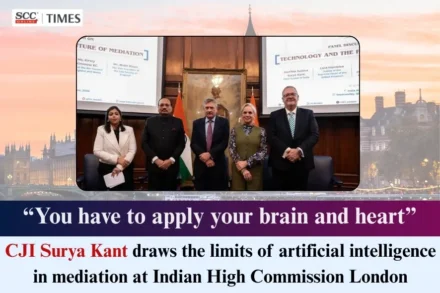
At the Mediation Event organised by the Indian High Commission in London, the panelists reinforced that the future of mediation lies not in replacing human mediators with artificial intelligence, but in creating a collaborative model where technology strengthens human-led dispute resolution while preserving its core values of trust, human perception, and understanding.

India UK FTA arbitration mediation 2026
Events & CollaborationsGCAI ConferenceInternational

At the 2026 GCAI Conference on India-UK Partnership, the esteemed panellists discussed achieving the Viksit Bharat 2047 goal by making changes in legal institutions, providing access to justice with technology, using mediation in investor-state disputes, navigating AI in Law, and much more.

force majeure geopolitical risk arbitration Geopolitical Disputes
Events & CollaborationsLondon International Disputes Week

A sanctions designation in Washington can simultaneously trigger a force majeure notice in Singapore, a MAC dispute in London and a valuation fight in a treaty arbitration. Five practitioners at LIDW 2026 examined each front, and found the same issue at the centre of every one: causation.

AI in the Legal Profession
Events & CollaborationsLondon International Disputes Week

Artificial intelligence is making lawyers faster, research more accessible and legal services more efficient. But as AI systems become increasingly sophisticated, legal practitioners are confronting a more difficult question: how can the profession embrace technological transformation without surrendering the human judgment, ethics and accountability that lie at the heart of legal practice?

crypto arbitration digital assets
Events & CollaborationsLondon International Disputes Week

From Bitcoin loans worth pennies at issuance to claims that doubled in value before the award, leading practitioners at LIDW 2026 examined whether arbitration can deliver the speed, certainty and enforceability that the digital-asset sector demands and found that the answer depends entirely on how fast the mechanisms adapt.

AI future international dispute resolution
Events & CollaborationsLondon International Disputes Week

Reflecting on nearly five decades in the legal profession, from manual typewriters to AI, Sir Geoffrey warned that the competition to develop national AI capabilities is simultaneously a competition to preserve the influence of established legal systems, and that courts which resist this reality risk making themselves irrelevant.

Rule of Law under Pressure
Events & CollaborationsLondon International Disputes Week

From Brexit to the erosion of US institutional independence, a former Downing Street Chief of Staff, a former Lord Chancellor and a former US Ambassador agreed that the rule of law must now be actively defended — not assumed — at a time when legal institutions face unprecedented political challenge.

GCAI India-UK Partnership Conference 2026 (2)
Events & CollaborationsGCAI ConferenceInternational

The General Counsels’ Association of India is hosting a high-level conference titled ‘India—UK Partnership — Cooperation, Investment and the Future’ on 5 June 2026 at Governor’s House, London, hosted by Bryan Cave Leighton Paisner and supported by the Law Society of England and Wales.

arbitration costs proportionality
Events & CollaborationsLondon International Disputes Week

Can arbitration deliver better value than litigation? At LIDW 2026, leading practitioners debated proportionality, cost recovery, case management and procedural innovations, concluding that efficient dispute resolution depends less on the forum chosen and more on the decisions made by clients, counsel, tribunals and institutions.