BCI Announces Major Reforms Following Supreme Court Directions; National Legal Academy Proposed
Can these reforms redefine the future of the legal profession? Following the Supreme Court’s judgment in Ajay Vijh v. Indian Banks Association, the

Bringing you the Best Analytical Legal News


Can these reforms redefine the future of the legal profession? Following the Supreme Court’s judgment in Ajay Vijh v. Indian Banks Association, the
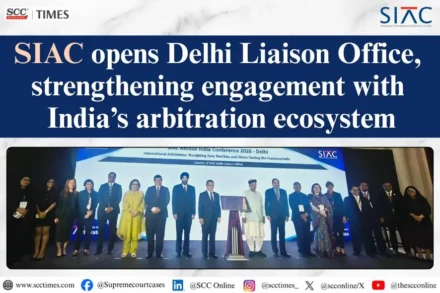
SIAC has inaugurated its Delhi Liaison Office during the SIAC Annual India Conference 2026, marking a significant expansion of its presence in India and strengthening engagement with the country’s arbitration ecosystem.
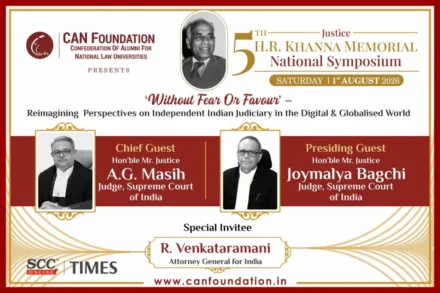
The Symposium is being organised virtually in honour of Late Justice H. R. Khanna, whose unwavering commitment to constitutional morality, judicial independence and civil liberties continues to inspire generations of lawyers, judges and legal scholars.

CAM acted as legal advisor for Dixon. Its role included undertaking legal due diligence on VMI, advising on structuring of the transaction, and review and negotiation of transaction documents (including joint venture agreement, shareholders agreement and asset purchase agreement).

Can your lawyer deduct unpaid legal fees from your compensation? The Delhi High Court recently clarified that agreed professional fees may

Lawrence Teh highlighted the importance of institutional trust, judicial restraint, and cultural understanding in international arbitration, while encouraging Kazakhstan to build an arbitral identity rooted in its own strengths rather than replicating existing models.

The Innovator’s Dilemma comes for law firms: Nikki Shaver on five signals that the legal industry is at an inflection point at LegalTechTalk 2026
From 400 to 1,000 generative AI products in twelve months, USD 4.28 billion in legal tech investment in 2025, and corporate legal AI adoption doubling from 24% to 52%, LegalTechnologyHub’s CEO argues that while law firms continue to report strong revenues, the structural forces reshaping the market are already in motion.
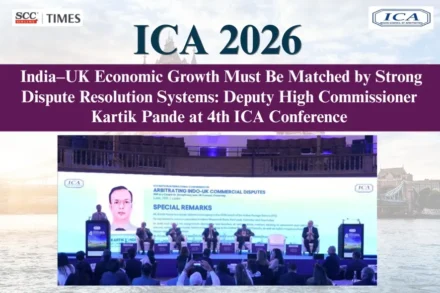
At the ICA Conference in London, Deputy High Commissioner Kartik Pande underscored the importance of arbitration and ADR in supporting the growing India—UK economic partnership and fostering commercial confidence in cross-border trade and investment.

The esteemed panel from 39 Essex Chambers and Field Fisher discussed intertwining criminal and commercial disputes, engagement of arbitral tribunals with corruption concerns, measures taken by solicitors, and much more at LIDW 2026.
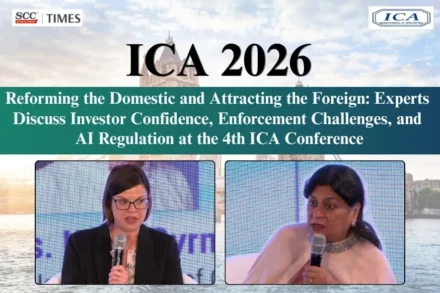
The fireside chat at the 4th ICA Conference on “Arbitrating Indo-UK Commercial Disputes” examined the challenges of enforcement, arbitration efficiency, judicial intervention, institutional reforms, AI regulation, third-party funding, and investor confidence.
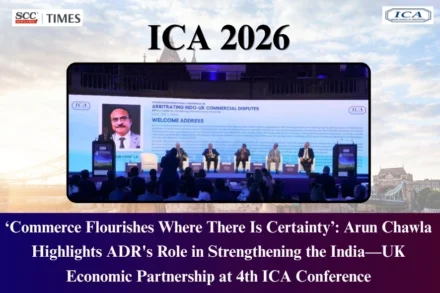
In 1774, Lord Mansfield observed that ‘in all mercantile transactions the great object should be certainty.’ Two hundred and fifty years later, Arun Chawla, Director General of ICA, used that same principle to frame the case for arbitration as the silent infrastructure of globalisation and for the India-UK economic partnership’s dependence on credible dispute resolution institutions.

At a panel discussion at the 4th ICA Conference on “Arbitrating Indo-UK Commercial Disputes”, the speakers agreed that while disputes may be inevitable in business, successful commercial ecosystems were defined not by the absence of disputes, but rather by avoiding them and if they arise, resolving them efficiently, fairly, and with minimal disruption to long-term relationships and commerce.

A sanctions designation in Washington can simultaneously trigger a force majeure notice in Singapore, a MAC dispute in London and a valuation fight in a treaty arbitration. Five practitioners at LIDW 2026 examined each front, and found the same issue at the centre of every one: causation.
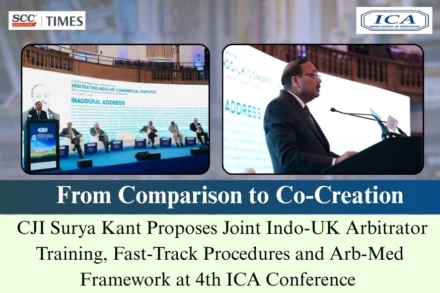
The Chief Justice of India delivered a thought-provoking keynote address at the 4th International Conference of the ICA on Arbitrating Indo-UK Disputes, urging the global arbitration community to return to the foundational purpose of arbitration and ensure that dispute resolution remains accessible, efficient, and responsive to the needs of modern commerce.

At a formal LIDW 2026 debate hosted by RPC and Stephenson Harwood, counsel argued both sides of a motion to replace human arbitrators with AI while the Tribunal called the whole question a false binary. The debate on AI arbitrators was more candid surprising than most.

From Bitcoin loans worth pennies at issuance to claims that doubled in value before the award, leading practitioners at LIDW 2026 examined whether arbitration can deliver the speed, certainty and enforceability that the digital-asset sector demands and found that the answer depends entirely on how fast the mechanisms adapt.

Sir Geoffrey Vos, Former Chief Justice of India D.Y. Chandrachud, VK Rajah SC and Dr. Emilia Onyema examined whether digital justice systems, AI and accountability can deliver meaningful access to justice or whether the technology divide will deepen the inequalities they are meant to solve.

In a wide-ranging interview at LIDW 2026, the former Coca-Cola Europacific Partners General Counsel reflects on cross-border disputes, AI’s impact on legal practice, access to justice, and why she would choose the same career again. In an interesting segment of LIDW 2026, Mr. Hilton Mervis, Litigation Partner, McDermott Will & Schulte, held an engaging conversation with Ms. Clare Wardle, Former General Counsel and Company Secretary, Coca-Cola Europacific Partners, on her insights as a general counsel.

From Brexit to the erosion of US institutional independence, a former Downing Street Chief of Staff, a former Lord Chancellor and a former US Ambassador agreed that the rule of law must now be actively defended — not assumed — at a time when legal institutions face unprecedented political challenge.