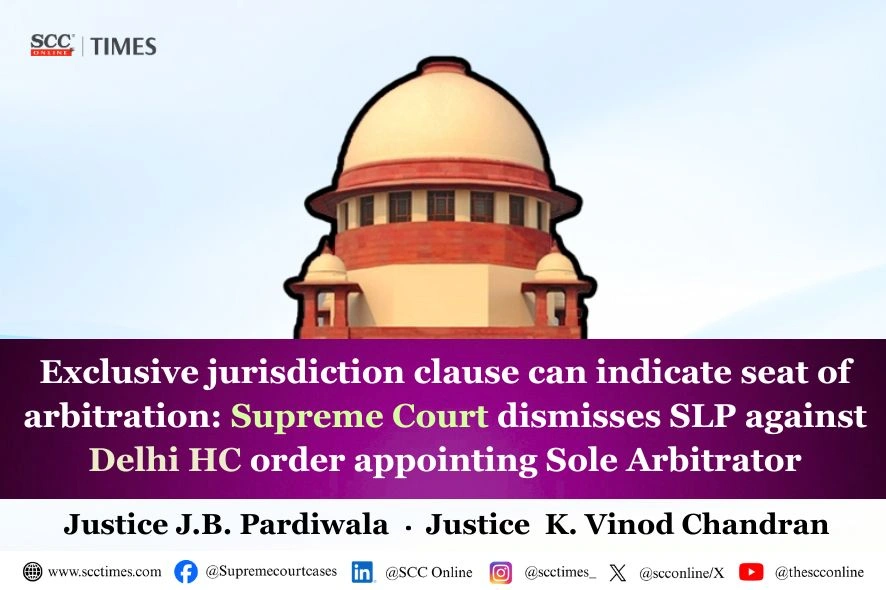
Supreme Court: While considering a special leave petition challenging the order passed by the Delhi High Court appointing a Sole Arbitrator under Section 11(5) read with Section 11(6), Arbitration and Conciliation Act, 1996, a Division Bench comprising of J.B. Pardiwala and K. Vinod Chandran, JJ., held that there was no good ground to interfere with the impugned order passed by the High Court.
The High Court had held that an exclusive jurisdiction clause stipulating that courts at New Delhi shall have exclusive jurisdiction, in the context of arbitration proceedings, must be construed as indicative of the seat of arbitration.
The present issue arose from a petition filed under Section 11(5) read with Section 11(6), Arbitration and Conciliation Act, 1996, by Pidge Technologies (P) Ltd seeking appointment of a Sole Arbitrator for adjudication of disputes arising out of a Merchant Services Agreement dated 18 September 2024 executed between the parties. Pidge Technologies (P) Ltd, a logistics platform operator and service provider, had engaged Sliksync Technologies (P) Ltd for providing manpower through delivery partners/riders. Sliksync Technologies (P) Ltd was contractually obligated to provide accurate data, including rider information and cash on delivery payment details, to facilitate operations and payments.
It was stated that Sliksync Technologies (P) Ltd failed to fulfil its contractual obligations by providing incorrect data sets and rider information, resulting in operational disruptions, including delays in salary payments to riders and a strike by riders. Despite the alleged lapses, Pidge Technologies (P) Ltd continued to provide services, resulting in outstanding dues of ₹2,09,81,622 for the months of September, October and November 2025. Pidge Technologies (P) Ltd issued a legal notice dated 5 December 2025 demanding payment of outstanding dues. Sliksync Technologies (P) Ltd, instead of clearing the dues, raised allegations of operational difficulties and GMV losses, which were denied by Pidge Technologies (P) Ltd.
Pidge Technologies (P) Ltd thereafter invoked arbitration under Clause 8 Agreement through notice dated 19 January 2026. Sliksync Technologies (P) Ltd, in its reply dated 5 March 2026, raised counterclaims of ₹4,50,00,000 towards losses allegedly suffered due to Pidge Technologies (P) Ltd’s actions and ₹8,00,000 towards delivery payments allegedly collected by Pidge Technologies (P) Ltd. Consequently, Pidge Technologies (P) Ltd approached the High Court seeking appointment of a Sole Arbitrator.
The principal issue before the High Court was whether it could exercise jurisdiction to appoint an arbitrator where the arbitration clause did not specify a seat or venue but stipulated that courts at a particular place shall have exclusive jurisdiction.
The High Court, upon perusal of Clause 8 of the Agreement, observed that the parties had agreed to resolve disputes through arbitration and had further stipulated that courts at New Delhi shall have exclusive jurisdiction in respect of disputes arising out of the Agreement. Relying upon the judgment of the Supreme Court in Activitas Management Advisor (P) Ltd. v. Mind Plus Healthcare (P) Ltd., 2025 SCC OnLine SC 3069, the High Court held that where an exclusive jurisdiction clause is provided in the context of dispute resolution through arbitration, the same must be construed as indicative of the seat of arbitration.
The High Court held that the facts of the present case were squarely covered by the aforesaid judgment, as the exclusive jurisdiction of courts at New Delhi had been agreed upon by the parties in the context of arbitration proceedings. Accordingly, the High Court held that it had jurisdiction to entertain the petition and appoint an arbitrator.
The High Court allowed the petition and appointed Varuna Bhandari Gugnani, Advocate, as the Sole Arbitrator to adjudicate the disputes arising between the parties. The arbitration proceedings were directed to take place under the aegis of the Delhi International Arbitration Centre (DIAC) and shall abide by its rules and regulations. The learned arbitrator was also directed to file the requisite disclosure under Section 12(2), Arbitration and Conciliation Act, 1996 within 2 weeks of entering the reference.
Aggrieved by the order passed by the High Court, Sliksync Technologies (P) Ltd preferred a special leave petition before the Court. Having heard the learned counsel appearing for Pidge Technologies (P) Ltd and having gone through the materials on record, the Court found no good ground to interfere with the impugned order passed by the High Court. Accordingly, the special leave petition was dismissed.
Also Read: Seat versus Venue: A Damsel Distressing Domestic Arbitrations | SCC Times
[Sliksync Technologies (P) Ltd. v. Pidge Technologies (P) Ltd., Petition for Special Leave to Appeal (C) No.22888 of 2026, decided on 27-7-2026]
Advocates who appeared in this case:
For Sliksync Technologies (P) Ltd: Azmat Hayat Amanullah, AOR, Samudra Sarangi, Saloni Jain, Yoshita Sood, Rebecca Mishra, Advocates
For Pidge Technologies (P) Ltd.: Ravi Sehgal, AOR, Saurav Agrawal, Asav Rajan, Anshuman Chowdhury, Ajay Sharma, Kashish Chadha, Roopali Lakhotia, Adithya S Nair, Advocates
Buy Arbitration and Conciliation Act, 1996 HERE